
The short answer
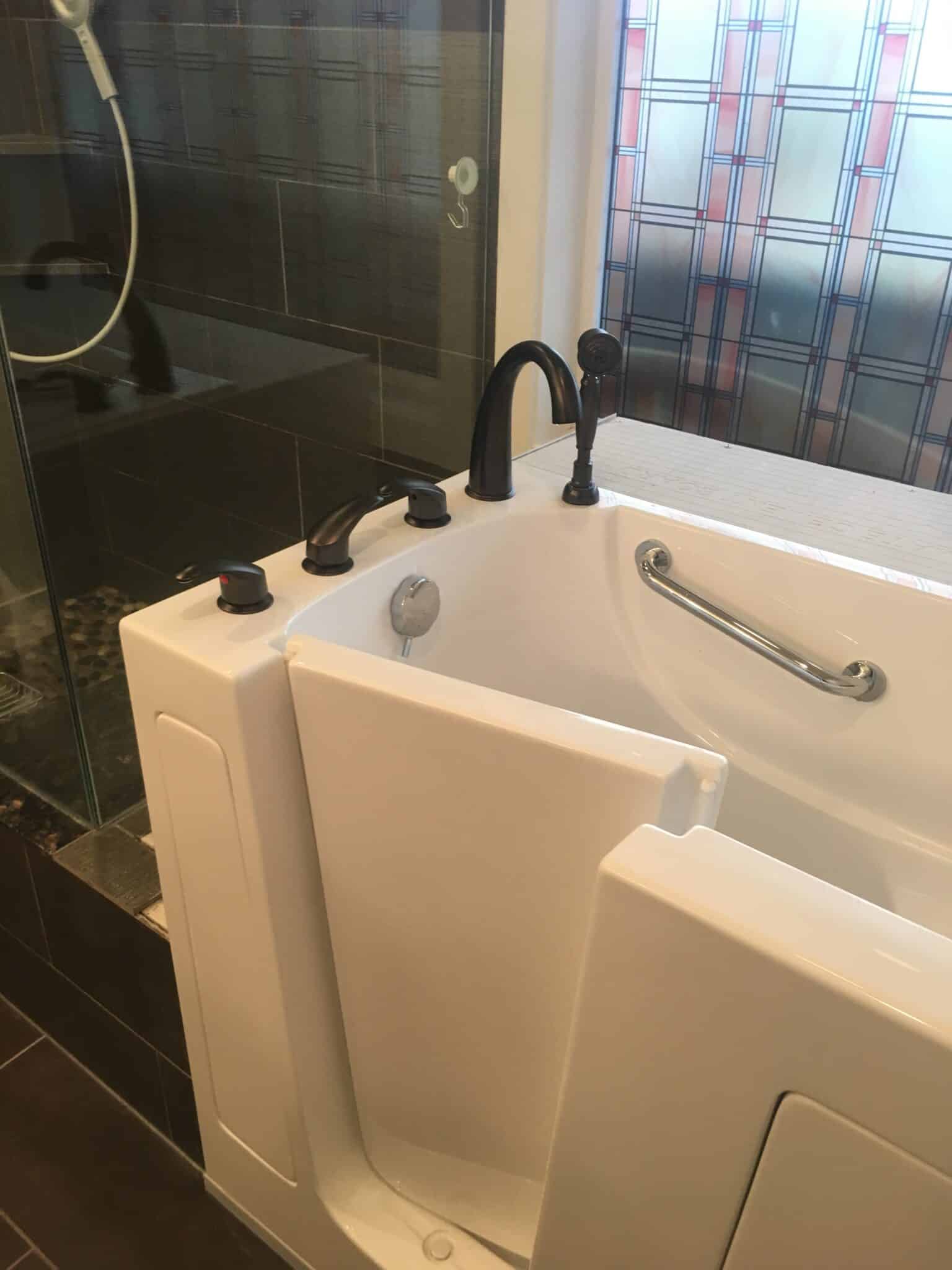
- A senior walk in bathtub replaces the tall wall of a standard tub with a watertight door, so you step in instead of climbing over.
- You sit on a built-in seat at chair height instead of lowering yourself to the tub floor.
- One-day installation is available in many areas. We confirm availability for your ZIP code when you call or request a quote.
- Prefer your own contractor? We drop-ship tubs anywhere in the United States and Canada.
- Published national estimates put an installed walk-in tub at roughly $3,500 to $10,000, with a $6,000 average (Fixr, 2026). Your quote depends on the model and your bathroom.
- Original Medicare generally does not pay for walk-in tubs, but grants, Medicaid waivers, VA benefits and tax credits sometimes help.
Why so many families are replacing the tub first
Ask anyone who has helped an aging parent at home, and you will hear the same story. The kitchen is fine. The stairs are manageable with a railing. But the bathtub becomes the one place where everyone holds their breath.
That worry is backed by real numbers. When the Centers for Disease Control and Prevention studied bathroom injuries treated in U.S. emergency rooms, it found that injury rates climb sharply with age. Adults 85 and older were injured in the bathroom at a rate of 515 per 100,000 people, nearly nine times the rate of adults in their late teens and early twenties. More than two out of three of those injuries happened in or around the tub or shower, and about 81% were caused by falls.
Source: CDC, MMWR 60(22), “Nonfatal Bathroom Injuries Among Persons Aged ≥15 Years — United States, 2008” (2011), Table 1.
Show the numbers
| Age group | Injuries per 100,000 |
|---|---|
| Ages 15–24 | 58.8 |
| 25–34 | 73.1 |
| 35–44 | 76.0 |
| 45–54 | 70.5 |
| 55–64 | 84.8 |
| 65–74 | 112.1 |
| 75–84 | 241.0 |
| 85 and older | 515.3 |
The problem is not bathing itself. It is the climb. A standard tub asks you to lift one leg over a wall that can be well over a foot tall, balance on a wet surface, then lower your whole body down to the floor of the tub. Getting out is harder. You have to push up from the bottom of a slippery basin, often with nothing solid to hold. That is exactly the motion that becomes risky as strength, balance and flexibility change.
A senior walk in bathtub takes that climb away. You open a door, step over a low threshold, sit down on a seat at roughly the height of a kitchen chair, close the door and let the water rise around you. When you are done, the water drains, you open the door and you stand up from a seat, not from the floor. For a lot of people, that one change is the difference between bathing on their own and needing help.
What makes a walk-in tub safer than a regular tub
Every walk-in tub for seniors is built around the same idea: remove the hard moves. Here are the features that do the real work, in the order most families should care about them.
- Low step-in threshold. Instead of stepping over the full tub wall, you step over a short sill. In the Ella’s Bubbles models reviewed by the National Council on Aging, the lowest step-in heights ranged from about 3 to 6 inches.
- Built-in, chair-height seat. Hydro Dimensions walk-in tubs, for example, come standard with a 17-inch-high seat. Sitting down and standing up from a seat is a motion most people already do dozens of times a day.
- Grab bars where your hands naturally go. Good tubs place a bar by the door and another near the seat, so you always have something solid to hold during the moments when balance matters most.
- Textured, slip-resistant floor. The floor of the tub is molded with texture so your feet have grip even when the surface is wet and soapy.
- Anti-scald protection. A thermostatic or anti-scald valve limits how hot the water can get, which matters for anyone with reduced sensation in the feet or legs.
- Fast-fill faucet and quick drain. Because you sit in the tub while it fills and drains, faucet flow and drain size decide how long you wait. Dual drains empty the tub noticeably faster than a single standard drain.
- Handheld shower. A hose-mounted shower lets you rinse your hair and body while seated, and lets a caregiver help without leaning over a tub wall.
Nice extras such as hydrotherapy jets, heated backrests and chromotherapy lights make a bath more enjoyable, and we are happy to add them. But if you are choosing on a budget, spend first on the fit, the door, the seat, the grab bars and the drain. Those are the parts that keep you safe every single day.
Two ways to get your tub: one-day installation or DIY delivery
Most walk-in tub companies only offer one path: an in-home sales visit followed by their own installation crew. We think families deserve a choice, so we offer two.
| One-day professional installation | DIY delivery to your door | |
|---|---|---|
| Who installs | Factory-certified installers | You, your plumber or your contractor |
| Where | Many areas across the U.S. (we confirm by ZIP) | Anywhere in the United States and Canada |
| Timeline | Most installs completed in one day once the tub arrives | Ships to your door; install on your schedule |
| Removal of the old tub | Included in the installation scope | Handled by your installer |
| Best for | Families who want one team and one day of disruption | Handy homeowners, rural addresses, contractors, Canadian buyers |
| Warranty | Manufacturer warranty plus a 1-year labor warranty from Aging Safely Baths | Manufacturer warranty plus a 1-year labor warranty from Aging Safely Baths |
One-day installation by factory-certified installers
When you choose installation, our installers remove the old tub, prepare the plumbing and walls, set the walk-in tub, connect the water and drain, test the door seal and jets, and clean up. In most homes that happens in a single day once the tub has arrived. If your bathroom needs extra work, such as moving a drain, adding an electrical circuit for jets or repairing a soft subfloor, we tell you before the job is scheduled, not halfway through it.
Learn exactly what happens on installation day in our walk-in tub installation guide.
DIY: drop-shipped to your door anywhere in the US or Canada
If you already have a trusted plumber or contractor, or you live somewhere big installation companies will not drive to, we ship the tub straight to you. You get the same brands, the same manufacturer warranties and the same product help from our team. We will send the spec sheets and rough-in dimensions your installer needs before the tub even arrives, so there are no surprises on the day it is set.
See how ordering, freight and delivery work on our buy a walk-in tub online page.
Which walk-in tub fits your body and your bathroom?
Walk-in bathtubs for elderly bathers are not one-size-fits-all. The right model depends on three things: how you move, how much room you have, and what you want the bath to do for you. Here is a plain-language map of the main types.
| Tub type | Who it suits | What to know |
|---|---|---|
| Soaking walk-in tub | Most seniors who want a safe, deep, warm bath | The simplest and most affordable option; no jets to maintain |
| Hydrotherapy walk-in tub | People with stiff joints, sore muscles or poor circulation who love a massage | Water jets, air jets or both; usually needs a dedicated electrical circuit |
| Bariatric or two-seat tub | Larger bathers, taller bathers, couples | Wider seats and doors; more water to heat |
| Wheelchair-accessible transfer tub | Wheelchair users and people who transfer from a chair or walker | Wide outward-swinging door so you slide across rather than step in |
| Small or compact walk-in tub | Small bathrooms, shower stalls, tight alcoves | Shorter length but deep seated soak; check the door swing |
| Lay-down walk-in tub | People who want to recline like a regular bath | Flat floor and longer length; needs a full-size alcove |
A few quick rules of thumb help narrow the choice fast:
- If you use a wheelchair or struggle to step even a few inches, start with a transfer tub that has an outward-swinging door.
- If the tub will replace a standard 60-inch tub, most models in the 52- to 60-inch range will fit the existing alcove.
- If you are a larger or taller bather, sit-test the seat width and ask for the interior dimensions, not just the outside size.
- If aches, arthritis or poor circulation are part of daily life, it is worth pricing a hydrotherapy upgrade.
- If you have a very small bathroom, look at compact and front-entry models before assuming a tub will not fit.
The brands we carry, and why
We are not tied to one factory, which means we can recommend the tub that actually fits you instead of the one we are required to sell.
Ella’s Bubbles: authorized dealer since 2012
Aging Safely Baths has been an authorized Ella’s Bubbles dealer since 2012. Ella’s Bubbles began in 2005 and is known for a wide lineup, including what it describes as the first two-person walk-in tub. Its range runs from compact models such as the 26-by-45-inch Mobile and the 32-by-40-inch Front Entry to the 30-by-52-inch Capri, with its 20-inch seat and outward-swinging door, up to the 36-by-80-inch Big4Two two-seat tub. Ella’s also makes wheelchair transfer tubs such as the Transfer60, which pairs a 22-inch-wide seat with a 36-inch L-shaped outward door and dual 2-inch drains.
Hydro Dimensions: our best value, with a lifetime warranty
Hydro Dimensions has been building walk-in tubs since 1993 and offers 16 models across its standard and specialty series, including bariatric and wheelchair-accessible designs. It is often our top recommendation for value. Hydro Dimensions backs its tubs with a lifetime warranty that covers the tub itself: the shell, frame, door seal, motors and parts. Always ask for the written warranty with your quote so you can read the exact terms.
Meditub and Bestbath
We also supply Meditub walk-in tubs and Bestbath products, including Bestbath roll-in showers and Rane walk-in tubs and transfer baths. If a walk-in shower or roll-in shower turns out to be the better answer for your household, we will tell you. For shower kits and replacement bases, our sister site Showers4Less has you covered.
What does a senior walk in bathtub cost?
Honest answer: it depends on the tub and on your bathroom. Published national estimates vary widely because they include different things.
Source: Fixr (updated Jan 2026); This Old House (updated Jun 2026); Retirement Living (2026).
Show the numbers
| Source | Low | High | Typical |
|---|---|---|---|
| Fixr | $3,500 | $10,000 | $6,000 |
| This Old House | $1,800 | $20,000 | $4,600 |
| Retirement Living | $4,000 | $22,100 | $13,100 |
Fixr puts the typical installed project between $3,500 and $10,000, with a national average of $6,000. This Old House reports about $4,600 for a standard 60-by-32-inch tub with mid-range materials, with a range of $1,800 to more than $20,000. Retirement Living reports a range of about $4,000 to $22,100. The spread comes from a handful of predictable factors:
- The tub itself. A basic soaking tub costs less than a hydrotherapy, bariatric or two-seat model.
- Therapy systems. Air jets, water jets, heated backrests and in-line heaters each add cost.
- Your plumbing and electrical. Jetted tubs usually need a dedicated circuit, and some homes need a bigger water heater.
- The condition of the bathroom. Rotten subfloor, old galvanized pipes or a tiled surround that has to be rebuilt all add labor.
- Who installs it. Professional one-day installation includes labor and removal. DIY delivery shifts that cost to your own installer.
We do not publish a price list because two bathrooms that look the same can need very different work. What we do promise is a clear, written quote that separates the tub, the options and the labor, so you can compare it line by line with anyone else. Our walk-in tub cost guide breaks every factor down in detail.
A walk-in tub costs less than leaving home
Here is the comparison many families find eye-opening. Most older adults want to stay put. AARP’s 2024 Home and Community Preferences Survey found that 75% of adults 50 and older want to remain in their current homes as they age, and 51% said they need a home that supports independent aging.
Source: AARP 2024 Home and Community Preferences Survey.
Show the numbers
| Statement | Share of adults 50+ |
|---|---|
| Want to stay in their current home | 75% |
| Want to stay in their community | 73% |
| Say they need a home that supports independent aging | 51% |
| Expect they will have to move | 44% |
When bathing becomes unsafe, the alternatives are expensive. According to CareScout’s 2025 Cost of Care Survey, the national median for an assisted living community is $6,200 a month, or $74,400 a year. A non-medical caregiver costs a median of $35 an hour, which works out to about $80,080 a year at 44 hours a week. A private nursing home room is a median of $129,575 a year.
Source: CareScout Cost of Care Survey, 2025 national medians; walk-in tub average from Fixr (updated Jan 2026).
Show the numbers
| Option | Cost |
|---|---|
| Nursing home, private room | $129,575 / yr |
| Nursing home, semi-private | $114,975 / yr |
| In-home caregiver, 44 hrs/week | $80,080 / yr |
| Assisted living community | $74,400 / yr |
| Walk-in tub, installed (average, one time) | $6,000 once |
A walk-in tub will not solve every aging-in-place challenge, and it is not a medical treatment. But when the tub is the main thing standing between someone and bathing independently, a one-time bathroom change that costs a fraction of a single year of assisted living is a very practical way to protect both safety and savings.
The honest drawbacks, and how we handle them
Any company that tells you a walk-in tub has no downsides is selling, not advising. Here is what to plan for.
You sit in the tub while it fills and drains
Because the door has to be closed before the water rises, you get in first and wait for the fill, then wait again for the drain before opening the door. In a cool bathroom that can feel chilly. The fixes are simple: a fast-fill faucet, dual drains, a heated seat or backrest, and a handheld shower to keep warm water on your shoulders while the tub fills. We size these options to your tub so wait times stay reasonable.
You need enough hot water
Walk-in tubs are deeper than regular tubs, and many hold more water. If your water heater is small, the last few gallons may run lukewarm. We check your heater size before you buy, and our water heater guide includes a calculator you can use in thirty seconds.
The door seal must be installed and cared for correctly
A walk-in tub door works like a car door gasket. Installed correctly, it is watertight for years. Installed carelessly, it can drip. That is exactly why we use factory-certified installers and test the seal before we leave, and why the manufacturer warranties we carry cover the door seal.
It is a permanent change to the bathroom
A walk-in tub replaces your existing tub. If other people in the home prefer to stand and shower, choose a model with a handheld shower and a wall kit, or talk to us about a walk-in tub and shower combination.
How our one-day installation works
We keep the process short and predictable, because a bathroom that is torn apart for weeks is its own safety hazard.
- Free consultation. Contact our team by phone, email or form. We ask about the bathroom, who will use the tub and any mobility needs, then confirm whether one-day installation is available at your address.
- Measurements and recommendation. We confirm the alcove size, doorways, water heater and electrical, then recommend two or three models that fit, with a written quote.
- Order and delivery. Your tub ships to your home or to our installers. We schedule the install date with you.
- Installation day. Our factory-certified installers remove the old tub, set and connect the new one, test the door seal, fill, drains and jets, and clean up.
- Walkthrough. Before we leave, we show you and your family how to use every control, the door latch and the drain, and we answer every question.
Paying for a walk-in tub: Medicare, grants and tax credits
This is one of the first questions families ask, so here is the straight answer. Original Medicare generally does not cover walk-in tubs, because they are treated as home modifications rather than durable medical equipment. That said, several programs can help, depending on who you are and where you live:
- Medicare Advantage plans sometimes include supplemental home-safety benefits. Coverage varies by plan, so call your plan and ask specifically about bathroom safety modifications.
- Medicaid waiver programs, often called Home and Community-Based Services waivers, may pay for home modifications in some states when they are medically necessary.
- VA benefits. The Home Improvements and Structural Alterations (HISA) grant provides a lifetime benefit of up to $6,800 for service-connected conditions and up to $2,000 for other conditions, applied for through a VA medical center with VA Form 10-0103.
- U.S. federal taxes. IRS Publication 502 explains when home modifications made for medical reasons can be counted as medical expenses.
- Canada. The federal Home Accessibility Tax Credit lets eligible Canadians claim up to $20,000 a year in qualifying renovation costs for a senior or a person eligible for the disability tax credit, for a credit of up to $3,000.
We do not give tax or legal advice, but we will gladly provide itemized invoices, product specifications and letters describing the safety features so you can submit them to your plan, your VA prosthetics office or your accountant. Our Medicare, grants and tax credits guide walks through each program step by step.
Walk-in tubs for Canadian homeowners
Most American walk-in tub companies stop at the border. We do not. We drop-ship senior walk-in tubs to homeowners and contractors across Canada, so you can have your own licensed plumber install it. Ask about freight, brokerage and any duty costs when you request a quote, so the full delivered price is clear before you order.
Canadian families have strong reasons to plan ahead. The Public Health Agency of Canada reports that between 20% and 30% of seniors fall each year, that falls cause 85% of seniors’ injury-related hospitalizations, and that half of the falls that lead to hospitalization happen at home. The federal Home Accessibility Tax Credit and the medical expense tax credit can both apply to qualifying accessibility renovations, so keep every invoice.
For adult children and caregivers
Many of our first calls come from a son or daughter, not the person who will use the tub. If that is you, a few tips from thousands of conversations:
- Start with the conversation, not the catalog. Ask your parent what part of bathing feels hardest: getting in, getting out, standing in the shower, or the fear of being alone if something goes wrong. Their answer tells you which tub to consider.
- Frame it as independence, not decline. A walk-in tub means they can keep bathing privately, on their own schedule, without asking for help. Most people respond well to that.
- Include them in the choice. Let them sit in the seat, test the door latch and feel the height of the grab bars if they can. A tub they chose is a tub they will use.
- Think five years ahead. If a walker or wheelchair is likely, a transfer tub or wider door now avoids a second remodel later.
- Loop in the whole family early. When siblings share costs, a clear written quote that separates the tub, options and labor makes the conversation easier.
Why families choose Aging Safely Baths
- BBB Accredited with an A+ rating.
- An authorized Ella’s Bubbles dealer since 2012, and a Hydro Dimensions, Meditub and Bestbath supplier, so we can recommend what fits rather than what we are required to sell.
- Two ways to buy: one-day installation by factory-certified installers in many areas, or DIY delivery anywhere in the US and Canada.
- Warranties that matter: manufacturer warranties, including Hydro Dimensions’ lifetime warranty on the tub, plus our own 1-year labor warranty.
- No-pressure advice. We explain the trade-offs, including the downsides, and we put the quote in writing.
Source: CDC, MMWR 67(18), 2018 (2007 and 2016 figures); National Safety Council, Injury Facts: Older Adult Falls (2024 figure).
Show the numbers
| Year | Deaths from falls, age 65+ |
|---|---|
| 2007 | 18,334 |
| 2016 | 29,668 |
| 2024 | 43,020 |
The trend is moving the wrong way. The National Safety Council reports that 43,020 adults 65 and older died from falls in 2024, and that older-adult fall deaths rose 51% over the past ten years. A walk-in tub is one of the most direct changes you can make to the room where so many of those falls start.
Walk-in tub, walk-in shower or roll-in shower?
A walk-in tub is not the only way to make bathing safer, and we sell all three options, so we have no reason to push one over another. Here is how they compare in everyday life.
| Walk-in tub | Walk-in shower | Roll-in shower | |
|---|---|---|---|
| How you get in | Step over a low threshold and sit | Step over a low curb | Roll or walk in with no curb |
| How you bathe | Seated, immersed in warm water | Standing, or seated on a shower seat | Seated in a shower wheelchair or on a fold-down seat |
| Best for | People who love a soak, sore joints, those who tire standing | People who prefer showers and can step a few inches | Wheelchair users and people who need caregiver help |
| Waiting | Sit while the tub fills and drains | None | None |
| Water use | More | Less | Less |
If you love to soak, or standing in a shower wears you out, a walk-in tub is usually the right call. If you never take baths and can manage a small step, a low-curb walk-in shower may be simpler. If a wheelchair is part of daily life now, or likely soon, a roll-in shower or a wheelchair transfer tub deserves a close look. Our guide to walk-in tubs vs. roll-in showers goes deeper, and our wheelchair-accessible shower guide covers ADA dimensions.
The best choice matches how bathing actually happens in the home, today and a few years from now. That is the question we start every consultation with.
Guides for planning a safer bathroom
Before you buy, these research-backed guides answer the questions families ask most:
- Are walk-in tubs worth it? An honest look at the pros, cons and costs.
- Bathroom fall statistics for seniors, charted and sourced from the CDC, NSC and PHAC.
- Walk-in tub water heater guide, with a free hot water calculator.
- How to measure for a walk-in tub in about ten minutes.
- Walk-in tub vs. roll-in shower: which is better for seniors?
- Hydrotherapy benefits for seniors: what the research actually shows.
- Senior bathroom safety upgrades, in priority order.
- Wheelchair accessible shower guide with ADA sizes.
Frequently asked questions
What is a senior walk in bathtub?
A senior walk in bathtub is a bathtub with a watertight side door, a low step-in threshold and a built-in seat. You open the door, step in, sit down and close the door before the tub fills. It removes the need to climb over a tall tub wall or lower yourself to the tub floor, which are the moments when many bathroom falls happen.
How long does it take to install a walk-in tub?
In many homes, our factory-certified installers complete the installation in one day once the tub has arrived. Extra work, such as moving a drain, adding an electrical circuit for jets or repairing a damaged subfloor, can add time, and we tell you about it in writing before the job is scheduled.
Is one-day installation available in my area?
One-day installation is available in many areas across the United States. Call 1-888-779-2284 or request a quote with your ZIP code and we will confirm availability for your address. If installation is not available, we can drop-ship the tub to you for your own plumber or contractor.
Do you ship walk-in tubs to Canada?
Yes. We drop-ship walk-in tubs to homes and contractors anywhere in the United States and Canada. Ask about freight, brokerage and any duty costs when you request a quote so the delivered price is clear before you order.
How much does a walk-in tub cost?
Published national estimates vary. Fixr reports most installed projects cost $3,500 to $10,000, with a $6,000 average, while other publishers report ranges from under $2,000 to more than $20,000 for luxury models. Your price depends on the model, therapy options and the condition of your bathroom. We provide a written, itemized quote.
Does Medicare pay for walk-in tubs?
Original Medicare generally does not cover walk-in tubs because they are considered home modifications rather than durable medical equipment. Some Medicare Advantage plans, state Medicaid waiver programs, VA grants and tax rules may help with part of the cost, so check with your plan or program directly.
Will a walk-in tub fit where my current bathtub is?
Usually, yes. Many walk-in tubs are designed to fit a standard 60-inch tub alcove, and compact models are available for smaller spaces. We confirm the length, width, doorway widths and water heater capacity before you order.
How long do I wait for the tub to fill and drain?
Because you sit in the tub while it fills and drains, wait time depends on your faucet’s flow, your water pressure, the tub size and the drain. Fast-fill faucets and dual drains shorten the wait noticeably, and a heated seat or handheld shower keeps you warm in the meantime.
Do walk-in tubs leak?
A properly installed walk-in tub door is watertight. Leaks almost always come from installation errors or a neglected door seal. We use factory-certified installers, test the seal before we leave, and carry brands whose warranties cover the door seal.
What warranty comes with the tub?
Warranty terms depend on the manufacturer and model. Hydro Dimensions provides a lifetime warranty on its walk-in tubs, covering the shell, frame, door seal, motors and parts. Aging Safely Baths adds a 1-year labor warranty on both installed and supply-only orders. We include the written warranty with every quote.
Sources
- CDC, MMWR: Nonfatal Bathroom Injuries Among Persons Aged ≥15 Years, United States, 2008
- National Safety Council, Injury Facts: Older Adult Falls
- CDC, MMWR: Deaths From Falls Among Persons Aged ≥65 Years, 2007–2016
- AARP, 2024 Home and Community Preferences Survey
- CareScout, Cost of Care Survey
- Fixr, Walk-in Tub Installation Cost
- This Old House, Walk-In Tub Cost
- Retirement Living, Why Are Walk-In Tubs Expensive?
- National Council on Aging, Ella’s Bubbles Walk-In Tub Review
- Public Health Agency of Canada, Seniors’ Falls in Canada: Second Report
- IRS Publication 502, Medical and Dental Expenses