
The short answer
- A walk-in tub suits people who love to soak and can step over a low threshold or transfer to a seat.
- A roll-in shower suits wheelchair users, people who cannot step even a few inches, and people who need hands-on caregiver help.
- The 2010 ADA Standards set a minimum roll-in shower of 30 by 60 inches with a 60-inch entry, plus a 36-by-60-inch alternate design.
- Walk-in tubs mean waiting while the tub fills and drains; roll-in showers have no wait.
- Roll-in showers usually use less hot water than a full walk-in tub bath.
- A wheelchair transfer tub is a middle option for wheelchair users who can transfer and want to soak.
The quick answer
Choose a walk-in tub if the person loves baths, finds standing in a shower tiring, can step over a low threshold of a few inches or transfer to a seat, and would benefit from warm water or jets.
Choose a roll-in shower if the person uses a wheelchair full-time and cannot transfer safely, cannot lift a foot even a few inches, prefers showers, or needs a caregiver to help with bathing.
Consider a wheelchair transfer tub if the person uses a wheelchair but can slide across to a seat and really wants to soak. Our wheelchair-accessible walk-in tub guide covers these in detail.
At Aging Safely Baths we sell walk-in tubs from Ella’s Bubbles, Hydro Dimensions and Meditub, and Bestbath roll-in showers, so we have no reason to steer you one way. The right answer depends entirely on the person.
Side-by-side comparison
| Walk-in tub | Roll-in shower | |
|---|---|---|
| Entry | Door with a low threshold, often 3 to 6 inches | No curb, or a very low beveled threshold |
| Bathing position | Seated, immersed in warm water | Seated on a shower wheelchair or fold-down seat, or standing |
| Wheelchair access | Only with a transfer model and a transfer | Roll straight in on a shower wheelchair |
| Soaking and jets | Yes | No |
| Waiting | Sit while the tub fills and drains | None |
| Hot water use | Higher, a full tub | Lower, flow only while showering |
| Caregiver access | Good with an outward door | Excellent, with room to stand inside |
| Space | Often fits a standard 60-inch tub alcove | ADA minimum 30 x 60 in; more room is better |
| Installation | Often one day as a tub replacement | Varies; floor and drain work for a curbless entry |
| Who else can use it | People who soak or take seated showers | Everyone, standing or seated |
Who a walk-in tub is best for
A walk-in tub shines for people who want to keep taking baths but struggle with the standard tub. The low step-in door removes the climb over the tub wall, and the chair-height seat removes the hardest move of all: getting up from the floor of the tub.
Walk-in tubs are especially good for people who:
- Love to soak, and would feel a real loss giving up baths.
- Get tired or dizzy standing in a shower.
- Have arthritis, stiffness or sore muscles that feel better in warm water.
- Can walk, even slowly with a cane, and step over a few inches.
- Want optional hydrotherapy jets or a heated backrest.
The data explains why the tub matters. In a CDC study of bathroom injuries treated in U.S. emergency departments, 68.3% happened in or around the tub or shower, and getting out of the tub or shower caused 9.8% of injuries, compared with just 2.2% for getting in. A walk-in tub changes the getting-out moment: you stand from a seat and step over a low sill instead of climbing out of a slippery basin. See our overview of senior walk in bathtubs.
Who a roll-in shower is best for
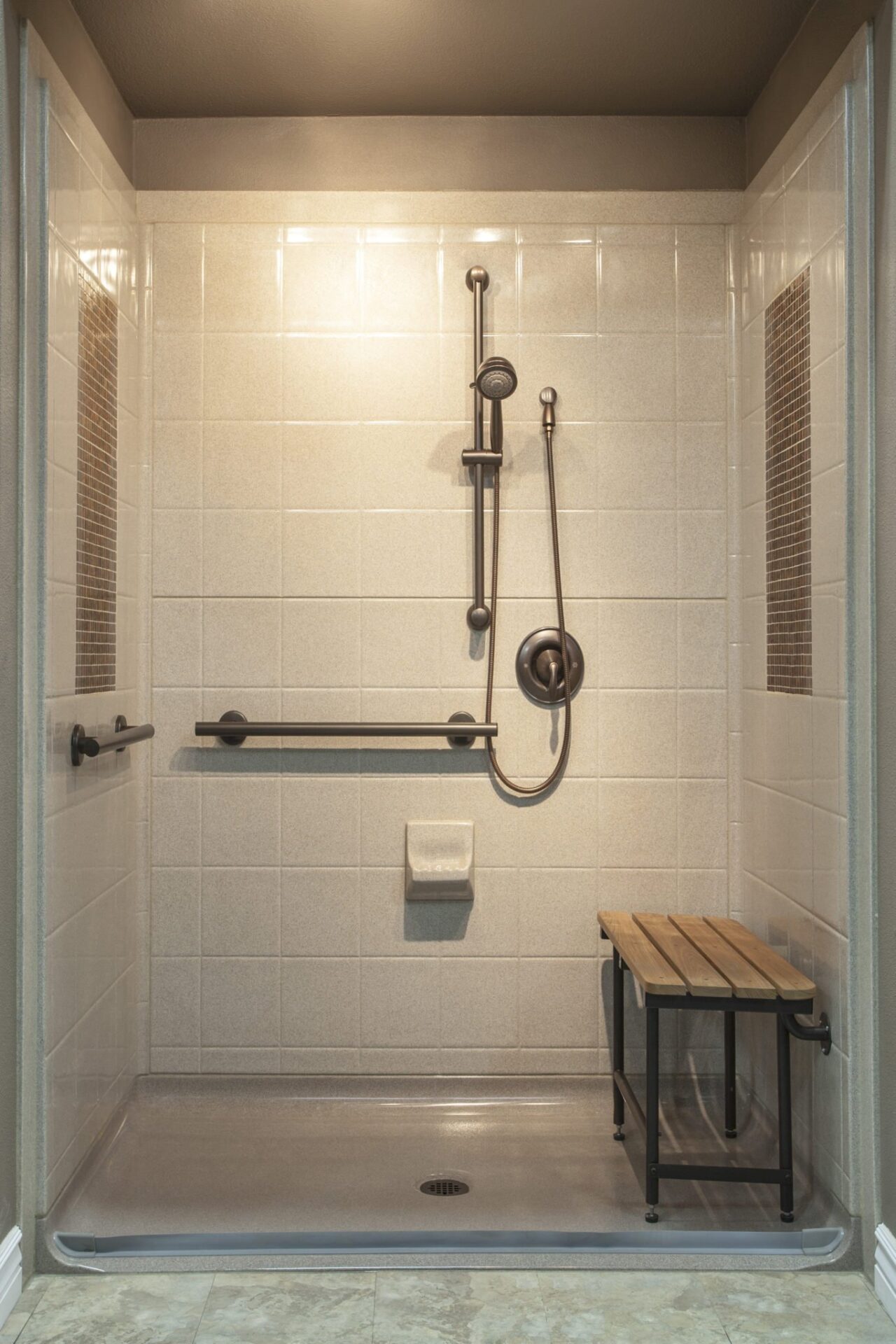
A roll-in shower removes the barrier entirely. There is no curb to step over, so a shower wheelchair can roll straight in, and a caregiver can stand inside to help.
Roll-in showers are especially good for people who:
- Use a wheelchair full-time and cannot transfer safely.
- Shuffle when walking or cannot lift their feet reliably.
- Need hands-on help with bathing from a caregiver.
- Prefer showers and rarely take baths.
- Need a bathroom that works for several people with different abilities.
ADA dimensions for roll-in showers
The 2010 ADA Standards for Accessible Design, which apply to public facilities, offer useful benchmarks for home roll-in showers:
- Standard roll-in shower: at least 30 inches wide by 60 inches long inside, with a 60-inch-wide entry.
- Alternate roll-in shower: 36 inches wide by 60 inches deep, with a 36-inch entry at one end of the long side.
- Transfer-type shower: 36 by 36 inches, used with a seat for people who transfer.
- Clear floor space: at least 30 by 60 inches outside a roll-in shower.
- Handheld shower: on a hose at least 59 inches long, usable fixed or handheld.
- Grab bars: mounted 33 to 36 inches above the floor.
- Seat height: 17 to 19 inches above the floor, where a seat is provided.
Many home roll-in showers are built larger than the minimum to give a caregiver room. Our wheelchair-accessible shower guide covers each requirement.
Safety compared
Both options are dramatically safer than a standard tub for most older adults, but the risks they address are different.
Walk-in tub risks center on the fill and drain wait and on stepping over the threshold. Anti-scald valves, heated seats, handheld showers, textured floors and grab bars reduce these risks.
Roll-in shower risks center on wet floors and water spreading beyond the shower area. A properly sloped floor, a collapsible water dam or a trench drain, slip-resistant flooring and grab bars address these risks.
For people who cannot step at all, a roll-in shower is safer. For people who can step a few inches but tire standing, a walk-in tub with a seat is often safer than standing in any shower.
Space and layout
A walk-in tub often fits right where a standard tub was, because many models are designed for a 60-inch alcove. Compact models fit smaller spaces, including some shower stalls. See our small walk-in tubs guide.
A roll-in shower also commonly replaces a 60-inch tub. The alcove becomes the shower, and a curbless entry is created. The bigger question is the floor: to eliminate the curb, the shower floor must slope to the drain while staying level with the bathroom floor, which may require floor work. Low-profile shower pans and trench drains help.
For wheelchair users, both options need clear floor space in the bathroom. A roll-in shower needs room to roll straight in; a transfer tub needs room to park beside the door.
Caregiving
If a caregiver helps with bathing, the choice matters for their safety too.
- Roll-in shower: the caregiver can step inside or stand at the open entry, with no tub wall to lean over. A handheld shower on a long hose makes rinsing easy. This is usually the easiest setup for hands-on help.
- Walk-in tub: an outward-swinging door lets the caregiver stand beside the bather. Helping is easier than with a standard tub, but there is still a tub wall between caregiver and bather once the door is closed.
For people who need significant help, most occupational therapists will favor a roll-in shower or a transfer tub with an outward door.
Water use, time and comfort
A walk-in tub bath uses more water than a typical shower, and much of it must be hot. At a 120°F heater setting and a 102°F bath, about 72% of the fill comes from the water heater. Check your heater with the calculator in our water heater guide.
A roll-in shower uses hot water only while the water runs, and there is no fill or drain wait. For people who get cold easily or cannot sit still for long, that is a real advantage.
On the other hand, many people find a warm, seated soak deeply comfortable, and some research on warm-water therapy for osteoarthritis supports that experience. See our hydrotherapy benefits guide.
Cost factors
Both walk-in tubs and roll-in showers vary widely in price. Published national estimates for walk-in tubs include Fixr’s range of $3,500 to $10,000 installed, with a $6,000 average. Roll-in shower costs depend heavily on how much floor work is needed to create a curbless entry, the shower system chosen and the wall finish.
Cost factors to compare:
| Factor | Walk-in tub | Roll-in shower |
|---|---|---|
| Product | Tub, door, seat, faucet, drain, optional jets | Shower pan or base, walls, seat, valve, handheld shower |
| Floor work | Usually minimal for a tub-for-tub swap | Often needed to create a curbless, sloped floor |
| Electrical | Needed for jets and heaters | Usually not needed |
| Water heater | May need an upgrade | Rarely needs an upgrade |
| Accessories | Grab bars outside the tub, handheld shower | Grab bars, fold-down seat, water dam |
See our walk-in tub cost guide for a full breakdown. For shower kits and bases, our sister site Showers4Less ships nationwide, and Aging Safely Baths carries Bestbath roll-in showers.
Planning for changing mobility
Mobility often changes over time. Think about the next five years, not just today.
- If mobility is stable, choose the option that suits how the person likes to bathe.
- If a walker is likely soon, favor an outward-opening walk-in tub or a roll-in shower.
- If a wheelchair is likely, a roll-in shower or a transfer tub avoids a second remodel.
- If the need is temporary, such as recovery from surgery, a tub transfer bench may bridge the gap.
An occupational therapist can help predict future needs and recommend the safest setup.
A simple decision guide
Answer these questions in order:
- Can the person transfer safely from a wheelchair to a seat? If no, choose a roll-in shower.
- Can the person step over a threshold of a few inches with a grab bar? If no, choose a roll-in shower or transfer tub.
- Does the person love to soak or benefit from warm water? If yes, a walk-in tub or transfer tub is worth considering.
- Does the person get cold easily or dislike waiting? If yes, a roll-in shower may be more comfortable.
- Will a caregiver help with most baths? If yes, favor a roll-in shower or an outward-door transfer tub.
- Is the water heater large enough for a deep tub? If not, factor in an upgrade or choose a shower.
Real-world scenarios
These common situations show how the choice usually plays out.
A retired couple, both mobile, one with knee arthritis. They love baths, but the standard tub is getting hard to climb out of. A walk-in tub with a handheld shower serves both: one soaks, the other showers seated or standing.
A widow who uses a walker and gets cold easily. She prefers showers and dislikes waiting in a tub. A low-curb walk-in shower with a fold-down seat and handheld shower is likely the better fit.
A veteran who uses a wheelchair full-time and has a caregiver. Transfers are difficult. A roll-in shower with a shower wheelchair removes transfers entirely and gives the caregiver room.
A man recovering from a stroke who can transfer with help and misses baths. A wheelchair transfer tub with an outward L-shaped door lets him slide across to the seat and soak.
A family planning for a parent with a progressive condition. Mobility is likely to decline. A roll-in shower or transfer tub now avoids a second remodel later.
Can you have both?
In larger bathrooms, some families install a walk-in tub and a separate roll-in shower. In homes with two bathrooms, one can have a walk-in tub and the other a roll-in shower. If you have only one bathroom and are unsure, think about who uses it most and how their needs may change. We are happy to talk through the layout with you.
Questions to ask before deciding
- How does the person prefer to bathe today?
- Can they stand safely for a few minutes?
- Can they step over a few inches with a grab bar?
- Can they transfer from a wheelchair safely?
- Who else uses the bathroom?
- How is their mobility likely to change?
- How large is the water heater?
Getting the details right, whichever you choose
Whichever option you choose, the details decide how safe it is. For a walk-in tub, look at the threshold height, the door direction, the seat height, the drain speed and anti-scald protection. For a roll-in shower, look at the threshold, the floor slope, the grab bar positions, the seat and the reach of the handheld shower. In both cases, involve the person who will bathe, and if possible an occupational therapist, before finalizing the design.
Get a recommendation for your home
Still unsure? Call Aging Safely Baths at 1-888-779-2284 or request a free quote. Tell us how the person bathes today, what feels hardest, and the size of the space. Because we supply both walk-in tubs and roll-in showers, we will recommend whichever is genuinely safer for your household, and explain why.
There is no wrong choice between two safe options. The wrong choice is leaving a standard tub in place when it has already become hard to use.
Frequently asked questions
Which is safer for seniors, a walk-in tub or a roll-in shower?
It depends on the person. For people who cannot step even a few inches or who use a wheelchair, a roll-in shower is safer. For people who can step a few inches but tire standing, a walk-in tub with a seat is often safer than standing in a shower.
Is a walk-in tub or roll-in shower better for a wheelchair user?
A roll-in shower is usually best for wheelchair users who cannot transfer safely. Those who can transfer and want to soak may prefer a wheelchair transfer tub with a wide outward door.
What size is an ADA roll-in shower?
The 2010 ADA Standards set a minimum of 30 by 60 inches inside with a 60-inch entry, and an alternate design of 36 by 60 inches. Home roll-in showers are often built larger for caregiver room.
Does a roll-in shower use less water than a walk-in tub?
Usually, yes. A walk-in tub bath fills the tub, and much of that water must be hot. A shower uses water only while it runs.
Can I put a roll-in shower where my bathtub is?
Often, yes. A standard 60-inch tub alcove can frequently become a roll-in shower, though creating a curbless, sloped floor may require floor work.
Can a walk-in tub be used as a shower?
Yes. With a handheld shower on a slide bar, a tall enough surround and a curtain or screen, a walk-in tub can be used for seated or standing showers.
Which is easier for caregivers?
Roll-in showers are usually easiest, because there is no tub wall and the caregiver can stand inside. A walk-in tub with an outward door is a good second option.
Which costs more?
Either can cost more depending on the project. Walk-in tubs with jets need electrical work and sometimes a water heater upgrade; roll-in showers often need floor work to remove the curb. Compare itemized quotes for your bathroom.