
The short answer
- Transfer tubs use a wide, often L-shaped outward-swinging door so a wheelchair user can slide across onto the seat.
- Ella’s Bubbles offers several wheelchair-accessible models, including the Transfer60 with a 36-inch L-shaped door and 22-inch-wide seat.
- The seat height should be close to the wheelchair seat height for a level transfer.
- Leave clear floor space beside the tub for the wheelchair and, if needed, a caregiver.
- If the bather cannot transfer safely, a roll-in shower may be the better choice; ADA roll-in showers are at least 30 by 60 inches.
- Veterans may qualify for the VA HISA grant, up to $6,800 for service-connected conditions.
Why a standard walk-in tub is not enough for wheelchair users
A standard walk-in tub is a huge improvement over a regular bathtub for people who can walk, even slowly. You step over a low threshold of a few inches and sit down. But for someone who uses a wheelchair full-time, or who cannot lift a foot safely even a few inches, stepping in is still the problem.
A wheelchair-accessible walk-in tub changes the motion entirely. Instead of standing and stepping, the bather transfers sideways: the wheelchair is parked beside the tub, the door is opened wide, and the bather slides from the wheelchair seat onto the tub seat, often with a transfer board or a caregiver’s help. Then the legs are brought in, the door is closed, and the tub fills.
Transfers are a real risk moment. In the CDC’s study of bathroom injuries treated in emergency departments, the researchers counted “transferring,” defined as moving between a wheelchair or walker and the toilet, sink, shower or tub, as its own category of injury. A tub designed around a sideways, level transfer is about making that moment as controlled as possible.
How a transfer tub works
Transfer tubs share a few defining features.
- A wide outward-swinging door. Many transfer tubs use an L-shaped door that opens on both the side and the front corner, leaving a wide, clear path to the seat. Ella’s Transfer60, for example, uses a 36-inch L-shaped outward door.
- A seat close to the door. The seat sits right at the opening so the transfer distance is short.
- A wide seat. Room to land safely and shift into position. The Transfer60’s molded seat is 22 inches wide.
- A low or barrier-free sidewall at the entry. So the bather slides across rather than lifting over.
- Grab bars within reach from the seat. For pulling into position and steadying during the transfer.
- A door latch that can be operated from the seat. So the bather or caregiver can close and open it easily.
The Top Ten Reviews summary of Ella’s Bubbles notes that each of Ella’s wheelchair-accessible tubs uses an L-shaped, double-latch door that swings out to allow users to scoot in and out from their chair, and that Ella also offers an electronic lift for people who need more help getting in and out.
Transfer tub models we supply
We supply wheelchair-accessible tubs from several manufacturers, which lets us match the tub to the bather and the bathroom.
| Product line | Example | Published details |
|---|---|---|
| Ella’s Bubbles transfer tubs | Transfer60 | 30 by 60 inches, 22-inch-wide seat, 36-inch L-shaped outward door, dual 2-inch drains |
| Ella’s Bubbles transfer tubs | Transfer30 | 30 by 52 inches, outward-swinging door |
| Hydro Dimensions specialty series | Wheelchair-access models | Part of a 16-model lineup; lifetime warranty on the tub |
| Bestbath | Rane transfer baths | Transfer baths plus Bestbath roll-in showers |
Aging Safely Baths has been an authorized Ella’s Bubbles dealer since 2012 and is BBB Accredited with an A+ rating.
Sizing a transfer tub to the bather and the chair
A transfer tub has to fit three things: the bather, the wheelchair and the bathroom. Here is what to measure.
Seat height match
The easiest transfers happen when the wheelchair seat and the tub seat are close to the same height, so the bather slides across rather than up or down. Measure the height of the wheelchair seat cushion from the floor and compare it with the tub seat height from the bathroom floor. Small differences can often be managed with a transfer board; large ones make every transfer harder.
Transfer side
Most people transfer more easily toward one side. The door must open on the side that lets the bather move toward their stronger side. That determines whether you need a left-hand or right-hand door, which in turn determines where the drain and faucet must be.
Clear floor space beside the tub
The wheelchair needs to park parallel to the tub, right beside the door opening, with room for the footrests and for the door to swing fully open. If a caregiver assists, they need standing room as well. Measure the open floor space next to the tub before choosing a model.
Seat width and depth
The bather needs room to land on the seat with their hips fully supported, then rotate to face forward. Wider seats help, especially for larger bathers. See our bariatric walk-in tub guide for wider options.
Leg room
After the transfer, the legs have to be lifted over the low sidewall and brought into the footwell. Check the distance from the seat front to the footwell wall.
Transfer tub vs. roll-in shower: an honest comparison
For many wheelchair users, the right answer is a roll-in shower rather than any tub. We sell both, so here is a fair comparison.
| Wheelchair transfer tub | Roll-in shower | |
|---|---|---|
| How you enter | Transfer from wheelchair onto the tub seat | Roll in on a shower wheelchair or transfer to a fold-down seat |
| Bathing style | Seated, immersed in warm water | Seated shower |
| Transfers required | At least one each way | Possibly none with a shower wheelchair |
| Caregiver access | Good with an outward door | Excellent, with room to stand inside |
| Warm soak and jets | Yes | No |
| Minimum space | Varies by model, often a 60-inch alcove plus clear floor space | ADA minimum 30 by 60 inches inside, with clear space outside |
| Best for | Bathers who can transfer and want to soak | Bathers who cannot transfer safely, or prefer showers |
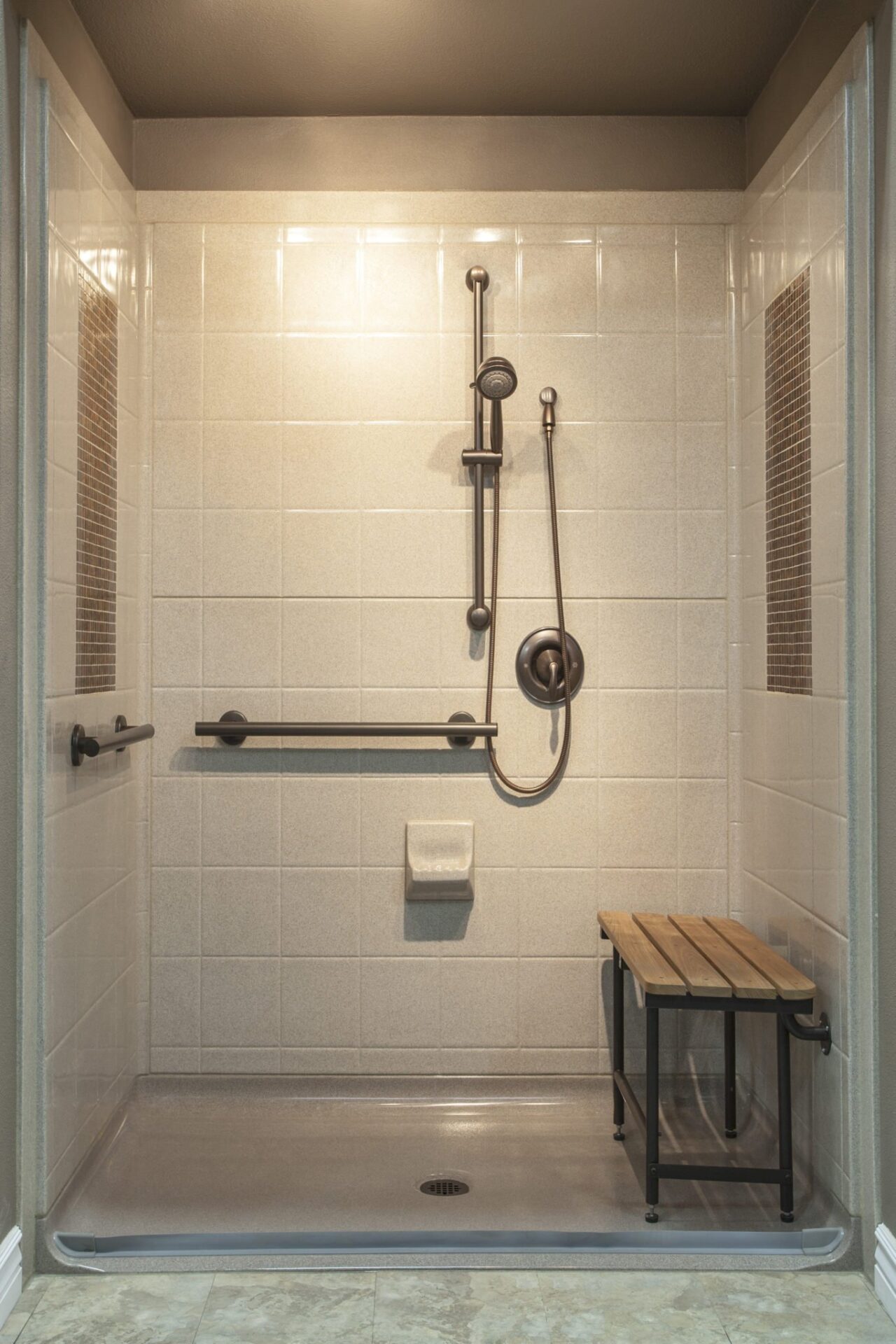
The 2010 ADA Standards for Accessible Design set a minimum roll-in shower size of 30 inches by 60 inches with a 60-inch-wide entry, and an alternate roll-in design of 36 by 60 inches. They call for a handheld shower spray unit on a hose at least 59 inches long, and grab bars mounted between 33 and 36 inches above the floor. Those standards apply to public facilities, but they are a helpful benchmark for home design.
If a bather cannot transfer safely, even with help, a roll-in shower with a shower wheelchair is usually the safer choice. If they can transfer and warm water is important to their comfort, a transfer tub gives them something a shower cannot. Our walk-in tub vs. roll-in shower guide and our wheelchair-accessible shower guide cover both in more depth.
Working with an occupational therapist
If the bather has had a stroke, spinal cord injury, amputation or another condition that affects transfers, an occupational therapist can be the most valuable person in the planning process. An OT can assess how the person transfers, which side is stronger, whether a transfer board or lift is needed, and what seat height works best. Bring their recommendations to your consultation, and we will match the tub to them. If you are working through the VA, the prosthetics and occupational therapy teams often coordinate home modification recommendations.
Features that matter most in a transfer tub
- Door width and swing. The wider and clearer the opening, the easier the transfer.
- Door latch design. Easy to reach and operate from the seat or by a caregiver.
- Grab bars positioned for pulling across and for steadying once seated.
- Handheld shower on a long hose. Makes rinsing easy for the bather or a caregiver.
- Heated seat or backrest. Wheelchair users often feel the cold during the fill and drain.
- Fast drain. Shortens the time before the door can be opened.
- Anti-scald protection. Especially important for people with reduced sensation in the legs or feet.
- Lift compatibility. If a powered lift is needed, check compatibility before choosing a tub.
Reduced sensation and water temperature
Many wheelchair users have reduced feeling in their legs or feet, which makes it harder to notice water that is too hot. Anti-scald or thermostatic valves limit the maximum water temperature. Set the water heater at a safe temperature, check bath water with a hand or thermometer before the legs go in, and ask your doctor or therapist what temperature is safe for you. The U.S. Department of Energy recommends a 120°F water heater setting for most households.
What a transfer bath looks like, step by step
Every person transfers a little differently, and an occupational therapist should teach the technique that is safest for you. But it helps to picture the routine before you choose a tub. Here is how a typical assisted or independent transfer bath works.
- Prepare the bathroom. Towels, clothing and toiletries are placed within reach of the tub seat. The handheld shower is within reach.
- Position the wheelchair. The chair is parked beside the tub door, as close and as parallel as possible, and the brakes are locked. Footrests are swung away.
- Open the door fully. The L-shaped outward door leaves the seat and entry wide open.
- Transfer to the seat. The bather slides across, often using a transfer board and a grab bar, with a caregiver steadying if needed.
- Bring the legs in. The legs are lifted over the low sidewall into the footwell, one at a time.
- Close and latch the door. From the seat, the bather or caregiver closes the door and secures the latch.
- Fill and bathe. The tub fills while the handheld shower keeps the bather warm. Jets are used if the tub has them.
- Drain completely. The door is not opened until the tub has fully drained.
- Reverse the transfer. Legs out, transfer back to the wheelchair, dry off while seated.
Looking at the routine this way shows why seat height, door width, grab bar position and clear floor space all matter so much.
Planning the whole bathroom for wheelchair access
A transfer tub only helps if the wheelchair can reach it. The 2010 ADA Standards, written for public buildings, offer useful benchmarks for home planning too:
- Doorways. The ADA calls for a clear door opening of at least 32 inches. Many older homes have narrower bathroom doors, and widening them, or using offset hinges, may be needed.
- Turning space. The ADA uses a 60-inch diameter circle as a benchmark for turning a wheelchair around. In a small bathroom, planning where the chair turns is as important as choosing the tub.
- Clear floor space at the tub. Room for the wheelchair to sit parallel to the tub door, plus room for a caregiver.
- Grab bars. Mounted securely into studs or blocking, at heights the bather can reach from the chair and the tub seat.
- Toilet and sink. A grab bar beside the toilet and knee space under the sink make the whole room usable.
- Flooring. Firm, slip-resistant flooring that the chair can roll across easily.
You do not need to rebuild the bathroom to public-building standards. But using these numbers as a guide avoids the frustration of a great tub the chair cannot actually reach.
Temporary or permanent need?
Not every wheelchair user will always use a wheelchair. After a hip or knee replacement, a stroke with good recovery, or a serious injury, the need may be temporary. Planning around that is worth a conversation.
- If the need is likely temporary, a shower chair or tub transfer bench with a handheld shower can bridge the gap for a few weeks.
- If the need is likely long-term or progressive, investing in a transfer tub or roll-in shower now avoids a second remodel later.
- If you are unsure, a transfer tub often serves both stages well, because people who later walk again can still step in through the wide door.
Mistakes to avoid with transfer tubs
- Choosing the door side without checking the transfer side. The door has to face the bather’s easier transfer direction.
- Ignoring seat height. A big mismatch between the wheelchair seat and the tub seat makes every transfer harder.
- Forgetting the door swing. An outward door needs clear space to open fully with the wheelchair parked beside it.
- Leaving no room for a caregiver. If help is needed now or later, plan standing room.
- Skipping the grab bar outside the tub. The transfer back to the chair needs support too.
- Not checking the path to the bathroom. A narrow hallway or door can block the whole plan.
A caregiver’s perspective
For family caregivers, bathing is often the most physically demanding and emotionally difficult task of the day. Lifting, leaning over a tub wall and worrying about slips take a toll. A transfer tub with an outward door lets the caregiver stand beside the bather rather than reaching over a wall. The handheld shower means rinsing without lifting. And because the bather is seated and supported, bath time can become calmer for both people. Many caregivers tell us the biggest change was not physical but emotional: bathing stopped being a daily source of dread.
Paying for a wheelchair-accessible tub
Several programs may help with part of the cost of accessible bathing equipment, depending on eligibility.
- VA Home Improvements and Structural Alterations (HISA) grant. A lifetime benefit of up to $6,800 for veterans with service-connected conditions and up to $2,000 for other conditions, for medically necessary home modifications. Veterans apply through the prosthetics department at their VA medical center with VA Form 10-0103 and a prescription or statement of need from their VA provider.
- VA Specially Adapted Housing grants for eligible veterans with certain severe service-connected disabilities.
- Medicaid waiver programs in many states cover home modifications for eligible people.
- Medicare Advantage plans sometimes include supplemental home-safety benefits.
- Tax rules. IRS Publication 502 explains when home modifications for medical reasons can count as medical expenses. In Canada, the Home Accessibility Tax Credit allows up to $20,000 of eligible expenses per year for qualifying individuals.
Our Medicare, grants and tax credits guide walks through each option.
Installation and delivery
Transfer tubs need careful installation: the tub must be level so the larger door seals evenly, the door must swing freely against its hinges, and the clear floor space beside the tub must stay open. Our factory-certified installers handle this in many areas, often in one day when the tub fits the existing space. If the bathroom needs wider doorways or floor changes for wheelchair access, we will tell you before scheduling.
We also drop-ship transfer tubs anywhere in the United States and Canada, with spec sheets and rough-in dimensions for your installer. Every tub includes the manufacturer’s warranty and a 1-year labor warranty from Aging Safely Baths.
Questions to ask before choosing a transfer tub
- What is the clear width of the door opening when fully open?
- Is the door left-hand or right-hand, and does it match the bather’s transfer side?
- How high is the seat from the bathroom floor, and how does that compare with the wheelchair seat?
- How wide and deep is the seat?
- Can the door latch be reached and operated from the seat?
- Where are the grab bars, and can more be added outside the tub?
- How much clear floor space does the open door need?
- Is the tub compatible with a transfer board or a powered lift?
- Does it have anti-scald protection and a handheld shower on a long hose?
- How fast does it drain, and is there a heated seat or backrest?
Privacy and dignity matter too
For many adults who use a wheelchair, the loss that hurts most is not mobility. It is privacy. Needing help with every bath can make a person feel like a patient in their own home. A well-chosen transfer tub can restore some of that independence: some bathers can transfer, bathe and dry off entirely on their own, and others need help only for part of the routine. Even small gains, like being able to latch the door and soak alone for twenty minutes, matter enormously. When we help families choose, we always ask the bather what independence means to them, and we design around the answer.
Where a transfer tub fits in the bathroom
Transfer tubs usually replace a standard tub in its existing alcove, with the wide door facing into the room. The key planning question is not the alcove but the floor in front of it: the wheelchair must park beside the door opening with the door fully open, and the bather must be able to approach, turn and leave without backing into the toilet or vanity. Sketch the room with the tub, door swing and wheelchair drawn in before you order, or send us a photo and rough measurements and we will do it with you.
Once the plan is on paper, you can see at a glance whether the room works as it is, or whether a door, vanity or toilet needs to move first.
Transfer tubs in shared homes
Transfer tubs also work for other members of the household. Because the wide door leaves an easy opening, people who walk can simply step in and sit down. With a handheld shower and a surround that reaches high enough, a transfer tub can also be used for seated showers. That makes it a practical choice for a couple where one partner uses a wheelchair and the other does not.
Why choose Aging Safely Baths for a wheelchair-accessible tub
We are not limited to one manufacturer’s transfer tub. As an authorized Ella’s Bubbles dealer since 2012, and a supplier of Hydro Dimensions, Meditub and Bestbath products including Rane transfer baths and Bestbath roll-in showers, we can recommend a transfer tub or a roll-in shower based on what is actually safest for the bather. We install in one day in many areas with factory-certified installers, ship anywhere in the US and Canada, and back every order with the manufacturer’s warranty and our own 1-year labor warranty.
Call 1-888-779-2284 or request a free quote. If an occupational therapist has made recommendations, send them along, and we will match the tub to them.
Frequently asked questions
What is a wheelchair-accessible walk-in tub?
A wheelchair-accessible walk-in tub, or transfer tub, has a wide door that swings outward, often in an L-shape around the tub’s corner, so a wheelchair user can pull alongside and slide across onto the seat rather than stepping in.
Can a wheelchair user use a regular walk-in tub?
Some can, if they are able to stand and step a few inches. For full-time wheelchair users, a transfer tub with a wide outward door, or a roll-in shower, is usually safer and easier.
Is a transfer tub or a roll-in shower better for a wheelchair user?
It depends on whether the person can transfer safely and whether soaking matters to them. A transfer tub offers a warm, seated soak but requires transfers. A roll-in shower can be used with a shower wheelchair and no transfer. An occupational therapist can help decide.
What size is an ADA roll-in shower?
The 2010 ADA Standards set a minimum roll-in shower of 30 by 60 inches inside with a 60-inch entry, and an alternate design of 36 by 60 inches. Many home installations go larger for comfort and caregiver room.
Does the VA pay for wheelchair-accessible tubs?
The VA HISA grant can help pay for medically necessary home modifications, with a lifetime benefit of up to $6,800 for service-connected conditions and up to $2,000 for other conditions. Veterans apply through their VA medical center’s prosthetics department.
Which way should the door open on a transfer tub?
The door should open toward the side the bather transfers from most easily, usually their stronger side. That choice decides whether you need a left- or right-hand model.
Can a caregiver help with transfers into a walk-in tub?
Yes. An outward-swinging door, grab bars on both sides of the entry, a handheld shower on a long hose and clear floor space beside the tub make caregiver-assisted bathing much easier.
Are there lifts for walk-in tubs?
Some manufacturers offer powered lifts. Ella’s Bubbles, for example, offers an electronic lift for people who need extra help getting in and out. Confirm compatibility with the tub model before ordering.
Sources
- CDC, MMWR: Nonfatal Bathroom Injuries Among Persons Aged ≥15 Years, United States, 2008
- Top Ten Reviews, Ella’s Bubbles walk-in tubs review
- Ella Transfer60 product listing (published specifications)
- Caring.com, Ella’s Bubbles walk-in tubs
- U.S. Access Board, ADA Standards: Shower Compartments (608)
- VA Prosthetic and Sensory Aids Service, HISA grant
- U.S. Department of Energy, Water Heating
- IRS Publication 502, Medical and Dental Expenses