
The short answer
- Bariatric walk-in tubs have wider seats, wider doors and more interior room than standard models.
- Retirement Living reports bariatric walk-in tubs typically cost $7,000 to $10,000.
- Ella’s Bubbles offers bariatric models with 20-inch-wide seats and two-seat tubs up to 36 by 80 inches (the Big4Two).
- Hydro Dimensions’ specialty series includes bariatric designs, backed by a lifetime warranty on the tub.
- Measure seat width, door opening and interior length, not just the outside size.
- Larger tubs need more hot water, so check your water heater before you buy.
Why standard walk-in tubs do not fit everyone
Most walk-in tubs are designed around an average-size bather. The seat is comfortable for most people, the door opening is wide enough for most people, and the space between the seat and the front wall leaves room for most people’s knees. But “most people” is not everyone.
For a larger bather, a standard walk-in tub can feel cramped in exactly the places that matter for safety. A narrow door opening means turning sideways to enter, which is harder to balance. A narrow seat means sitting on the edge instead of fully supported. A short distance between the seat and the front wall means knees pressed against acrylic and nowhere to shift. For a tall bather, a standard tub may leave the knees out of the water and the shoulders uncovered.
A bariatric walk-in tub solves these problems by adding space where the body needs it. Done right, it is not just more comfortable. It is safer, because you enter facing forward, sit fully supported, and stand up with room to move your feet under you.
What makes a walk-in tub “bariatric”
There is no single legal definition of a bariatric walk-in tub. In practice, manufacturers use the term for models that add some or all of the following:
- A wider seat. Ella’s Bubbles, for example, offers bariatric models with a 20-inch-wide seat.
- A wider door opening. Easier to enter facing forward, with or without a walker.
- More interior width. Room for the hips and arms beside the seat.
- More depth in front of the seat. Space for knees and feet, so you can stand up with your feet properly under you.
- Reinforced construction. A frame and floor designed for heavier loads.
- Longer interior length. Important for tall bathers who want their legs under water.
Some bariatric designs also use outward-swinging doors, which leave the whole opening clear as you step in.
Types of larger walk-in tubs
| Type | Typical size range | Who it suits | What to know |
|---|---|---|---|
| Wide-seat bariatric tub | Often 30 to 33 inches wide | Larger bathers who need a wider seat and door | Check the seat width and door opening, not just the outer width |
| Extra-long tub | 60 inches or more | Tall bathers who want legs covered | Needs a full-size alcove or larger |
| Two-seat tub | 32 by 60 inches up to 36 by 80 inches | Couples, or one bather who wants maximum room | Many exceed a standard alcove; plan for plumbing and floor space |
| Bariatric transfer tub | Varies | Larger bathers who transfer from a wheelchair | Wide L-shaped outward door for sliding across |
Two-seat walk-in tubs
Ella’s Bubbles is known for pioneering the two-person walk-in tub, and it offers several two-seat models. According to published product details, the Tub4Two measures 32 by 60 inches with seats of about 20 by 22 inches; the Companion is 32 by 60 inches with dual drains; the Escape is 36 by 72 inches with 27-by-29-inch seats and an inward door; and the Big4Two, Ella’s largest companion tub, measures 36 by 80 inches with a centered outward-swinging door, dual drains, and both hydro and air jets plus a foot massage section. Two-seat tubs are also popular with single bathers who simply want all that room to themselves.
Extra-long models for tall bathers
Tall bathers often find that their knees rise out of the water in a compact tub. Longer models solve that. The National Council on Aging’s review of Ella’s Bubbles notes that its outward-swing line includes a larger tub designed for taller people, including very tall bathers. Other longer options in the Ella range include the 27-by-60-inch Lounger and the 30-by-60-inch Ultimate.
Hydro Dimensions specialty series
Hydro Dimensions offers 16 walk-in tub models, including a specialty series with bariatric designs and tubs for wheelchair access. Hydro Dimensions tubs are backed by a lifetime warranty covering the shell, frame, door seal, motors and parts, which is especially reassuring on a larger tub that carries more weight.
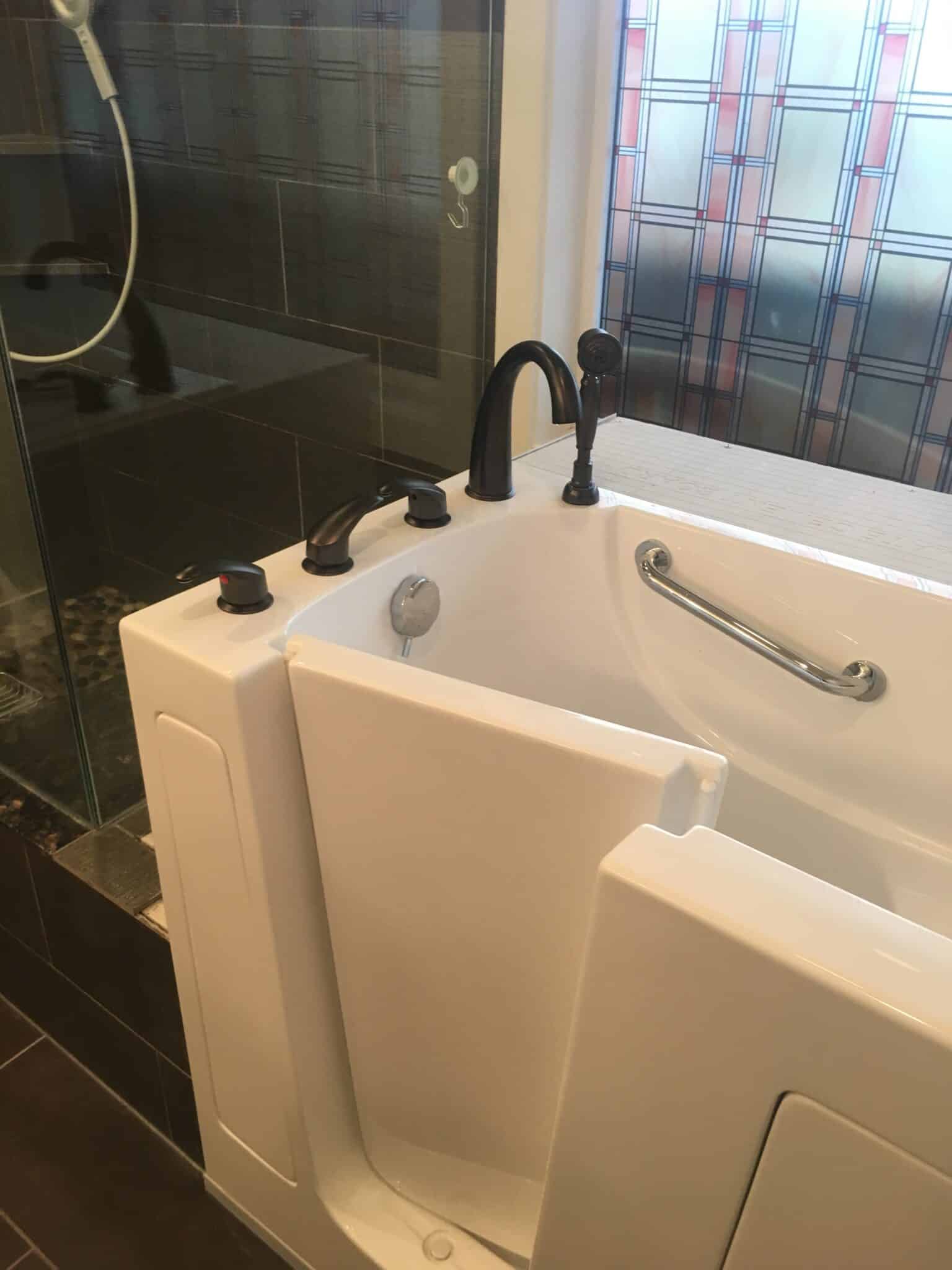
How to size a bariatric walk-in tub correctly
The outside dimensions of a tub tell you whether it fits the bathroom. The inside dimensions tell you whether it fits the bather. Here is what to measure and compare.
1. Seat width
Measure the bather’s hip width while seated in a firm chair, then add a few inches so they are not wedged in. Compare that to the seat width on the spec sheet. A seat that is too narrow means sitting partly on the edge, which is less stable.
2. Door opening
Look for the clear width of the door opening, not the size of the door panel. The bather should be able to walk in facing forward. If they use a walker, the opening and the space in front of the tub both need to accommodate it.
3. Knee and foot room
Sit in a chair and measure from the back of the seat to the front of the knees. The tub needs that distance plus room to shift the feet back when standing up. This is the measurement most often overlooked.
4. Seat height
A seat at roughly chair height makes sitting and standing easier. Hydro Dimensions tubs, for example, come with a 17-inch-high seat as standard. Taller bathers often prefer a slightly higher seat.
5. Interior length
For tall bathers, check the distance from the seat back to the footwell wall so the legs can rest comfortably under water.
6. Weight rating
Ask for the manufacturer’s stated weight guidance for the model, and confirm the floor structure under the tub is sound. A filled tub with a bather is heavy, and the floor must support it.
What a bariatric walk-in tub costs
Larger tubs cost more to build, ship and install. Retirement Living reports bariatric walk-in tubs typically cost $7,000 to $10,000, compared with $2,500 to $5,000 for a standard soaking tub. Fixr notes that two-seat walk-in tubs range from about $6,000 to $20,000 depending on features.
Source: Retirement Living (2026).
Show the numbers
| Tub type | Upper end of range |
|---|---|
| Standard soaking tub ($2,500–$5,000) | up to $5,000 |
| Air bath or hydrotherapy ($5,000–$10,000) | up to $10,000 |
| Bariatric ($7,000–$10,000) | up to $10,000 |
The cost drivers specific to larger tubs are:
- Size and materials. More acrylic, a larger frame and a bigger door.
- Freight. Bigger crates cost more to ship.
- Installation. Larger tubs may need a larger alcove, wall changes or floor reinforcement.
- Water heating. A bigger tub may need a larger water heater, an in-line heater or a tankless upgrade.
- Therapy systems. Jets are optional on most bariatric and two-seat tubs, and they add cost.
See the full breakdown in our walk-in tub cost guide.
Hot water: the biggest planning issue with large tubs
The single most common problem with large walk-in tubs is not the tub. It is the water heater. A two-seat or extra-long tub can hold far more water than a standard tub, and most of that fill needs to be hot.
At common settings, roughly 72% of a comfortable bath comes from the water heater. For an 80-gallon fill, that is about 58 gallons of 120°F water, which is more than many household tanks deliver before the temperature starts to drop. Before you choose a large tub, check your heater with the calculator below. Options if it falls short include a larger tank, a tankless water heater sized for the flow, an in-line heater on the tub, or choosing a model with a smaller fill volume.
Will your water heater fill a walk-in tub?
Pick your numbers. The math runs in your browser; nothing is sent anywhere.
Assumes a 120°F heater setting and that roughly 70% of a tank’s rated capacity comes out hot before the temperature drops. The first-hour rating on your heater’s yellow EnergyGuide label is the more exact number.
Floor and structure
A filled walk-in tub is heavy, and a large one is heavier still. Water weighs about 8.34 pounds per gallon, so every 10 gallons of water adds more than 80 pounds. Before a large tub is installed, the floor under it should be checked. Our installers inspect the subfloor and framing when the old tub comes out, and any reinforcement needed is quoted before installation day. This is especially important in second-floor bathrooms and manufactured homes.
Getting in and out: design details that help larger bathers
Beyond size, these details make a real difference:
- Outward-swinging doors leave the full opening clear as you step in.
- Grab bars on both sides of the entry, so either hand can steady you.
- A textured floor that extends to the threshold, so your first step is on grip.
- A handheld shower on a long hose, so rinsing does not require twisting.
- Dual drains, so the wait before opening the door is shorter.
- A heated backrest or seat, for warmth while filling and draining.
Bariatric tub or roll-in shower?
For some larger bathers, especially those who use a wheelchair or struggle to lift a foot even a few inches, a roll-in shower may be a better answer than any tub. Roll-in showers have no curb and allow a shower wheelchair or wide shower seat. The 2010 ADA Standards set a minimum roll-in shower size of 30 by 60 inches, and many families choose larger. We supply Bestbath roll-in showers as well as walk-in tubs, so we can recommend either honestly. Read our walk-in tub vs. roll-in shower guide.
Installation and delivery
Our factory-certified installers install bariatric and two-seat walk-in tubs in many areas, often in one day when the tub fits the existing alcove and the floor is sound. Larger tubs that need a bigger footprint, new plumbing or floor reinforcement can take longer, and we tell you before scheduling.
If you prefer to use your own installer, or you live in Canada, we drop-ship the tub to your door with spec sheets, rough-in dimensions and floor-load information for your contractor. Every tub includes the manufacturer’s warranty plus a 1-year labor warranty from Aging Safely Baths.
Talking about size with dignity
Families sometimes hesitate to ask about bariatric tubs because the conversation feels awkward. It should not be. Choosing a tub with the right seat and door is exactly like choosing a chair or a car that fits. When we help families size a tub, we ask for measurements the same way a tailor would, privately and matter-of-factly. The goal is simple: a bath that is safe, comfortable and dignified every single time.
Planning for a couple
When two people will share a walk-in tub, the choice gets more interesting. Some couples truly want to bathe together, and a two-seat tub with a centered door lets both enter easily. Others simply share one bathroom and have different needs: one wants a deep soak, the other wants a quick shower. For them, a single large tub with a handheld shower and a surround tall enough for standing showers is often the better fit. Tell us how you both bathe, and we will suggest the layout that works for each of you.
Larger walk-in tub models at a glance
The table below collects published dimensions for several larger Ella’s Bubbles models so you can compare footprints quickly. Always confirm the current spec sheet before ordering, since manufacturers update models.
| Model | Published size | Notable details |
|---|---|---|
| Ella Capri | 30 by 52 inches | 20-inch seat, outward-swinging door |
| Ella Lounger | 27 by 60 inches | Longer, narrower footprint |
| Ella Ultimate | 30 by 60 inches | Longer inward-door model |
| Ella Transfer60 | 30 by 60 inches | 22-inch-wide seat, 36-inch L-shaped outward door, dual 2-inch drains |
| Ella Tub4Two | 32 by 60 inches | Two seats of about 20 by 22 inches |
| Ella Companion | 32 by 60 inches | Two seats, dual drains |
| Ella Big4One | 33 by 66 inches | Extra room for one bather |
| Ella Escape | 36 by 72 inches | Two 27-by-29-inch seats, inward door |
| Ella Big4Two | 36 by 80 inches | Two seats, centered outward door, hydro and air jets, foot massage |
How much a filled tub weighs
Floor planning is easier when you see the numbers. Water weighs about 8.34 pounds per gallon, so the water alone adds up quickly. The tub itself and the bather add to these figures.
| Water in the tub | Weight of the water alone |
|---|---|
| 50 gallons | About 417 pounds |
| 70 gallons | About 584 pounds |
| 90 gallons | About 751 pounds |
| 120 gallons | About 1,001 pounds |
Most sound residential floors handle a standard tub easily. Larger tubs, older framing, second floors and manufactured homes deserve a closer look before installation.
Measuring the bather: a simple checklist
You do not need special tools. A tape measure, a firm dining chair and a helper are enough.
- Seated hip width. Sit in a firm chair and measure across the widest point of the hips and thighs. Add a few inches for comfort.
- Seat-back to knee. Measure from the chair back to the front of the knees.
- Seat-back to heel. Measure from the chair back to the heel with feet flat, to check leg room.
- Shoulder width. Helpful for judging the space between the grab bars and the tub walls.
- Height. Tall bathers should compare their height with the tub’s interior length.
- Mobility aids. Note whether a cane, walker or wheelchair is used, and its width.
Send these numbers with your quote request and we will match them to models that fit.
Common mistakes when buying a larger walk-in tub
- Buying by outside dimensions only. A 32-inch-wide tub can have a seat no wider than a 30-inch tub. Ask for seat width and door opening.
- Ignoring the water heater. The tub fits, but the bath runs lukewarm.
- Forgetting the path in. A two-seat tub may not make the turn into a small bathroom.
- Choosing a door that swings the wrong way. An outward door needs clear floor space in front of the tub.
- Skipping grab bars outside the tub. The step from the tub to the bathroom floor needs support too.
- Overlooking caregiver space. If someone helps with bathing, they need room to stand beside the tub.
The rest of a bariatric-friendly bathroom
A larger tub works best in a bathroom planned around the same needs. Consider:
- Wider doorways. Widening a narrow bathroom door makes entering with a walker easier.
- Grab bars rated for the load, anchored into studs or blocking, not just drywall anchors.
- A comfort-height or bariatric-rated toilet, with a grab bar beside it. The CDC’s bathroom injury study found that getting on and off the toilet became a larger share of injuries with age.
- Slip-resistant flooring outside the tub.
- Good lighting and a night-light.
- A sturdy bench or chair near the tub for drying off and dressing while seated.
When a caregiver helps with bathing
For larger adults who need hands-on help, the tub and the room both have to work for two people. An outward-swinging door gives the caregiver room to steady the bather. A handheld shower on a long hose lets the caregiver rinse without lifting or leaning. Grab bars on both sides of the entry give the bather two points of support. And a seat height that matches the bather’s wheelchair or chair makes transfers smoother. If transfers from a wheelchair are part of daily life, look closely at bariatric-capable transfer tubs.
Questions to ask before you buy a larger walk-in tub
- What is the seat width, and how deep is the seat front to back?
- What is the clear width of the door opening when fully open?
- How much room is there between the front of the seat and the front wall?
- What is the seat height from the tub floor and from the bathroom floor?
- What weight guidance does the manufacturer give for this model?
- How many gallons does it hold with a bather seated, and can my water heater fill it?
- Which way does the door swing, and how much floor space does it need?
- Will it fit through my doorways and hallway?
- Does the quote include floor inspection and any reinforcement?
- What does the warranty cover, especially the door seal and any motors?
Soaking or jets in a larger tub?
A larger tub gives jets more room to work, and many bariatric and two-seat models offer air, water or dual systems. But a larger jetted tub also means a bigger electrical load and more water to heat. If budget or hot water is tight, a large soaking tub with a heated backrest delivers comfort and safety without the extra systems. If you want massage, look at where the jets are placed relative to the wider seat, so they reach your back and legs rather than the space beside you. Our hydrotherapy walk-in tub guide explains the options.
Your first bath in a larger tub
Take the first bath with someone nearby. Practice opening and latching the door before filling the tub, sit down and stand up once while it is empty, and check that you can reach the grab bars and controls comfortably from the seat. Then fill it, enjoy it, and let it drain completely before opening the door.
Why families choose us for bariatric tubs
We are not limited to one factory’s sizes. Aging Safely Baths has been an authorized Ella’s Bubbles dealer since 2012 and also supplies Hydro Dimensions, Meditub and Bestbath, so we can match the seat, door and length to the bather instead of forcing the bather into whatever one brand makes. We are BBB Accredited with an A+ rating. We install in one day in many areas with factory-certified installers, or ship anywhere in the US and Canada. And every order carries the manufacturer’s warranty plus our own 1-year labor warranty.
Call 1-888-779-2284 or request a free quote. Send the bather’s measurements and a photo of the bathroom, and we will narrow the choices to the tubs that truly fit.
Frequently asked questions
What is a bariatric walk-in tub?
A bariatric walk-in tub is a walk-in tub designed with extra room for larger bathers, typically a wider seat, a wider door opening, more interior width and depth, and reinforced construction. It keeps the safety features of any walk-in tub: a low threshold, built-in seat and grab bars.
How much does a bariatric walk-in tub cost?
Retirement Living reports bariatric walk-in tubs typically cost $7,000 to $10,000, and Fixr reports two-seat tubs from about $6,000 to $20,000 depending on features. Installation, freight and water heater upgrades can affect the total.
How wide is the seat in a bariatric walk-in tub?
It varies by model. Ella’s Bubbles offers bariatric models with a 20-inch-wide seat, and some two-seat tubs have seats around 27 by 29 inches. Compare the seat width on the spec sheet with the bather’s seated hip width plus a few inches.
Will a bariatric walk-in tub fit in my existing tub space?
Some wide-seat models fit a standard 60-inch alcove, while two-seat and extra-long tubs often need more room. We check your alcove, doorways and floor before recommending a model.
Is there a weight limit for walk-in tubs?
Weight guidance varies by manufacturer and model, so ask for the stated specification for the tub you are considering. The floor under the tub must also be sound, since a filled tub with a bather is very heavy.
Do two-person walk-in tubs have two doors?
Most two-seat walk-in tubs have one door, often centered so both bathers can enter. Ella’s Big4Two, for example, has a centered outward-swinging door.
Will my water heater be big enough for a large walk-in tub?
Often not without planning. Roughly 72% of a comfortable bath comes from the water heater at typical settings, so large tubs can outrun a standard tank. Use our calculator, and ask about larger tanks, tankless heaters or in-line heaters.
Can a bariatric walk-in tub have jets?
Yes. Many bariatric and two-seat walk-in tubs are available with air jets, water jets or dual systems, and some two-seat models include a separate foot massage section.
Sources
- Retirement Living, Why Are Walk-In Tubs Expensive? (2026)
- Fixr, Walk-in Tub Installation Cost (2026)
- ConsumerAffairs, Best Two-Person Walk-In Tubs
- ConsumerAffairs, Ella’s Bubbles walk-in tub models
- National Council on Aging, Ella’s Bubbles Walk-In Tub Review
- Retirement Living, Ella’s Bubbles review
- ConsumerAffairs, Hydro Dimensions walk-in tubs
- U.S. Access Board, ADA Standards: Shower Compartments (608)